The Granularity Trap: why slicing your MMM data deeper doesn't bring you closer to the truth
More detail isn't more truth. Why slicing MMM data too finely destroys the signal — and how to find the "Goldilocks" granularity that actually drives decisions.
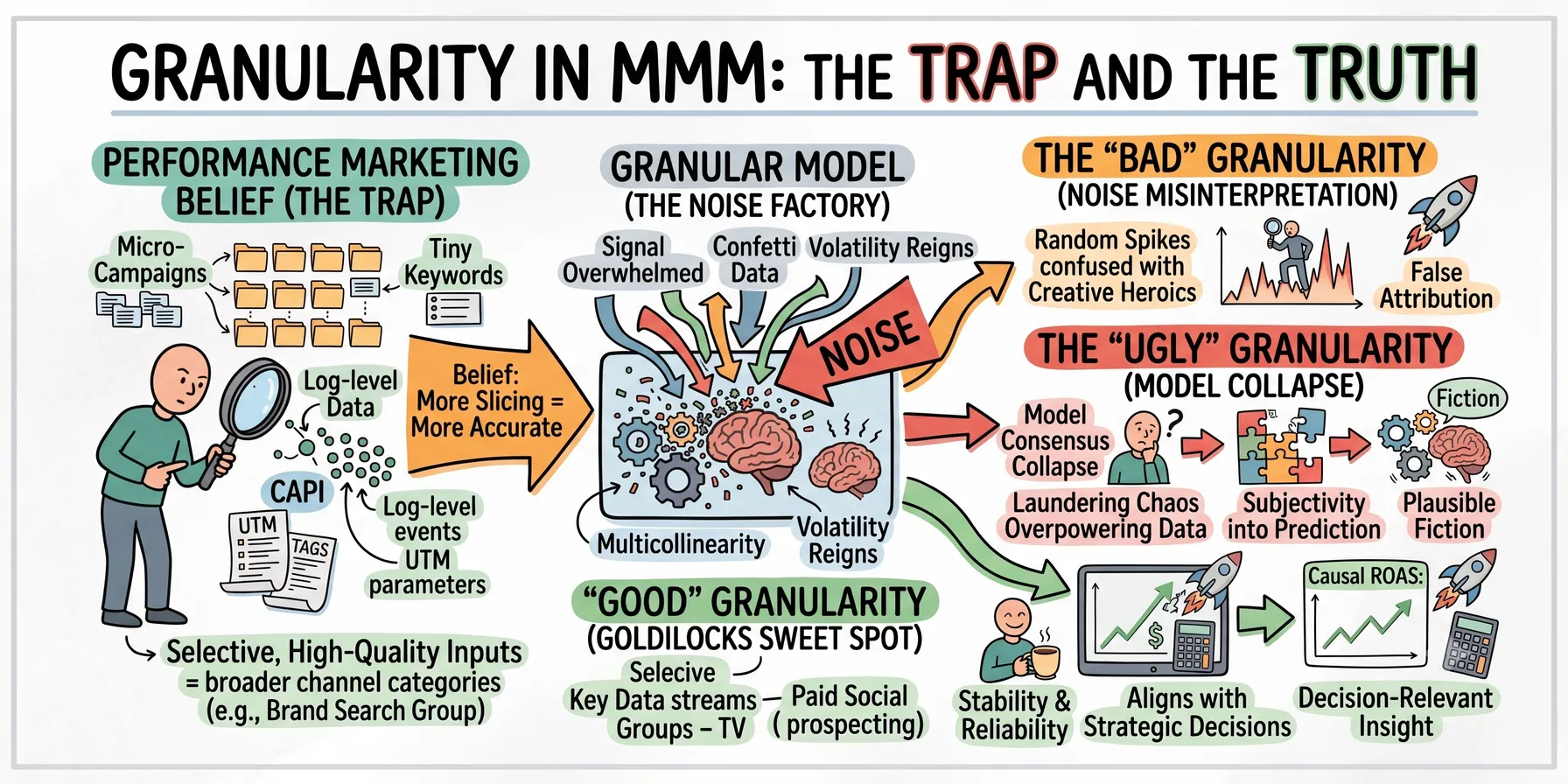
If you built your marketing career in the digital era, you were likely raised on a steady diet of high-resolution data. You are accustomed to dashboards brimming with log-level events, CAPI integrations, UTM parameters, and real-time click-through rates. In that world, the rule of thumb was simple: more detail equals more control, and more control equals better decisions.
Naturally, when modern marketing teams adopt Marketing Mix Modeling (MMM) to evaluate channel ROI, that same performance-marketing mindset kicks in. The immediate instinct is to ask:
- “Can we break this down by ad set and audience segment?”
- “Can MMM tell us which specific keyword drove incremental sales last Tuesday at 2:00 PM?”
- “Why are we looking at Paid Social as a single block when we run thirty different campaigns?”
The underlying belief is intuitive: the more granularly we slice and dice our data, the more accurately we can pinpoint true, causal ROI.
It sounds logical. But in the world of statistical modeling, this belief is not just flawed — it’s dangerous. Slicing your MMM data too finely doesn’t reveal the truth; it destroys it.
Here is why pushing for extreme granularity in MMM leads to unreliable models, statistical noise, and executive disappointment — and how to find the “Goldilocks” sweet spot that actually drives growth.
1. The physics of data: signal vs. noise
To understand why extreme detail breaks an MMM, you have to look at how data behaves at different scales. Think of it as the “physics” of statistical modeling.
When you evaluate a business at an aggregate level — looking at weekly national sales alongside overall spending in broad channels like Paid Search, Meta, TV, and YouTube — the data is stable. The major shifts in your marketing spend create clear, observable ripples in your baseline revenue. In statistical terms, the signal (the real effect of your marketing) easily stands out above the noise (random day-to-day market fluctuations).
Macro View (Broad Channels)  -->  High Signal, Low Noise  -->  Stable Model
Micro View (Ad Sets / Cuts)  -->  Low Signal, High Noise  -->  Unstable Guesswork
However, the moment you chop that data into micro-segments — by daily regional ad set, audience placement, or creative variant — consistent patterns evaporate. Volatility takes over. When you zoom in too far, natural random variation swamps genuine business signals. If sales spike in a tiny sub-segment, performance teams celebrate a “winning creative.” If sales drop, they panic. Nine times out of ten, neither reaction is justified — it is simply statistical randomness at play.
Even advanced Bayesian MMM algorithms, which are explicitly designed to handle variance, reach a breaking point. Force a model to evaluate hundreds of micro-inputs, and it can no longer separate meaningful business drivers from sheer background noise.
2. The shredded canvas: model instability and “plausible fiction”
There is a second, equally critical casualty of over-granularity: model instability.
To see how fine detail creates instability, consider an art-restoration analogy. Imagine asking five art experts to restore a classic masterpiece. If you give them twelve large, intact canvas sections, every expert will assemble virtually the same recognizable painting. But if you shred that canvas into 50,000 microscopic specks of confetti, consensus collapses. Given the exact same pile of dust, five different experts will glue together five completely different, wildly distorted pictures.
This is precisely what happens inside an MMM when you introduce too many variables. When you overload a model with every campaign variant, regional split, and tactical audience, you introduce multicollinearity — a scenario where multiple inputs move together in ways the model cannot separate. Meta ads, Google Search, promo emails, and regional pushes often run concurrently. If you ask the model to isolate the individual causal impact of 300 overlapping micro-variables, the math breaks down.
Instead of admitting defeat, statistical models will still output numbers. But those numbers become volatile and subjective. A model run today might tell you Campaign A has an ROI of 4.5, while a slight tweak to next week’s dataset claims Campaign A has an ROI of 0.2.
You haven’t gained deep insight. You’ve simply engineered plausible fiction — a complex, highly detailed report that feels authoritative because it has a lot of numbers, but actually reflects statistical hallucinations.
3. Right tool, right question
Much of the frustration around measurement stems from measurement teams and performance marketers talking past each other. They are trying to use one tool to solve every problem. Performance marketers who demand ad-level granularity from an MMM usually walk away disappointed, complaining:
- “All this model does is give me one number on a curve!”
- “It can’t tell me which creative variant I should turn off tomorrow!”
That disappointment is rooted in a tool mismatch. To build a cohesive measurement framework, leadership must align the tool to the specific question being asked:
| Measurement tool | What question does it answer? | Ideal granularity |
|---|---|---|
| Marketing Mix Modeling (MMM) | How much overall budget should we allocate across major channels to maximize revenue? | Macro (broad channel level, regional, or primary product lines) |
| Incrementality experiments | What is the true, unconfounded lift of a specific channel or major strategic initiative? | Strategic (geo-matched markets, holdout tests) |
| Attribution / platform analytics | How do we optimize creative, bidding, and keywords inside a specific channel short-term? | Micro (tactical, intra-platform, campaign / ad-set level) |
MMM was never designed to be a tactical microscope for intraday adjustments. It is a strategic telescope built to guide capital allocation. Expecting MMM to do the job of in-platform attribution is like trying to use a satellite map to navigate a parking garage.
4. “Goldilocks granularity”: aligning data with decision-making
If maximum detail isn’t the goal, what is? The target for executive leadership should be “Goldilocks granularity” — a structure that is neither too broad to be useful nor too fine to be stable.
The simplest way to find this balance is to filter your data requests through a single operational question:
“Will splitting this variable allow us to make a distinct, high-value business decision that we actually have the power to execute?”
If the answer is no, keep the data aggregated.
Guidelines for defining granularity in your MMM
- Group by strategic budget levers. If your CMO controls budget allocation at the channel level (e.g. shifting spend between Brand TV, Meta, YouTube, and Non-Brand Search), that is where your primary model structure should live.
- Separate funnel objectives, not every ad set. It often makes sense to split broad channels into major strategic tiers — such as separating Meta Prospecting from Meta Retargeting, or Brand Search from Generic Search. These represent fundamentally different strategic roles with different marginal-return curves.
- Respect the less-is-more principle. Overloading the model with every minor creative iteration degrades overall attribution accuracy. Selective, high-quality inputs allow the model to identify true causal relationships with far higher confidence.
Summary: focus on action, not detail for detail’s sake
The modern marketing executive does not suffer from a lack of data; they suffer from a surplus of distraction. It is easy to fall into the trap of assuming that a 50-page breakdown of ROI by sub-campaign is superior to a clean, 5-channel strategic overview. But true measurement accuracy is not measured by the number of rows in your spreadsheet. It is measured by the stability, reliability, and incrementality of the decisions that data enables.
Resist the temptation to demand micro-level answers from macro-level models. Use in-platform attribution and tactical testing to tweak your creative and keywords inside the funnel. Use incrementality tests to validate lift. And use MMM for what it does best: providing a stable, reliable foundation to allocate your overall marketing capital for maximum growth.